Book a Call

In a recent conversation with fellow MCC coaches working across regions, one sentence stopped the room: "It's not just uncertainty anymore. It's a loss of visibility."
No panic. But something quieter and more complex. A tension that is harder to name, and harder to carry.
What I am seeing now, across every market and every sector, is this: leaders are making critical decisions with limited clarity, adjusting constantly, and holding the weight of uncertainty for others, often without acknowledging what that weight is doing to them from the inside.
And from the inside is where I want to begin.
What losing the map actually looks like
I think of a leader I worked with not long ago. On the outside, everything appeared to be in order. Present. Active. In control.
But in our coaching space, something else was there. An anxiety that was not spoken, buried underneath a determined effort to "be resilient." The leader was standing against the crisis, rather than moving with it.
Neuroscientists recognise this pattern. Under prolonged pressure, the brain shifts into protective mode: not panic, but over-functioning. Intense thinking. Constant structuring. Relentless deciding. And gradually, a quiet disconnection: from the body, from emotions, from what is actually happening on the inside.
At first, it can look like a strength.
Within a month, there is exhaustion. And then something harder to articulate: a loss of purpose. A question the leader cannot quite put into words, even in the safety of a confidential space.
What is really happening when leaders lose balance
There are two levels to this, and they are not the same.
Externally, imbalance looks like acceleration. Longer hours, multiplied initiatives, constant motion. Some of this is strategic: in any crisis, some sectors grow while others stall. But for many leaders, the acceleration becomes something else. A way to stay busy. A way to avoid feeling the full weight of what is shifting around them.
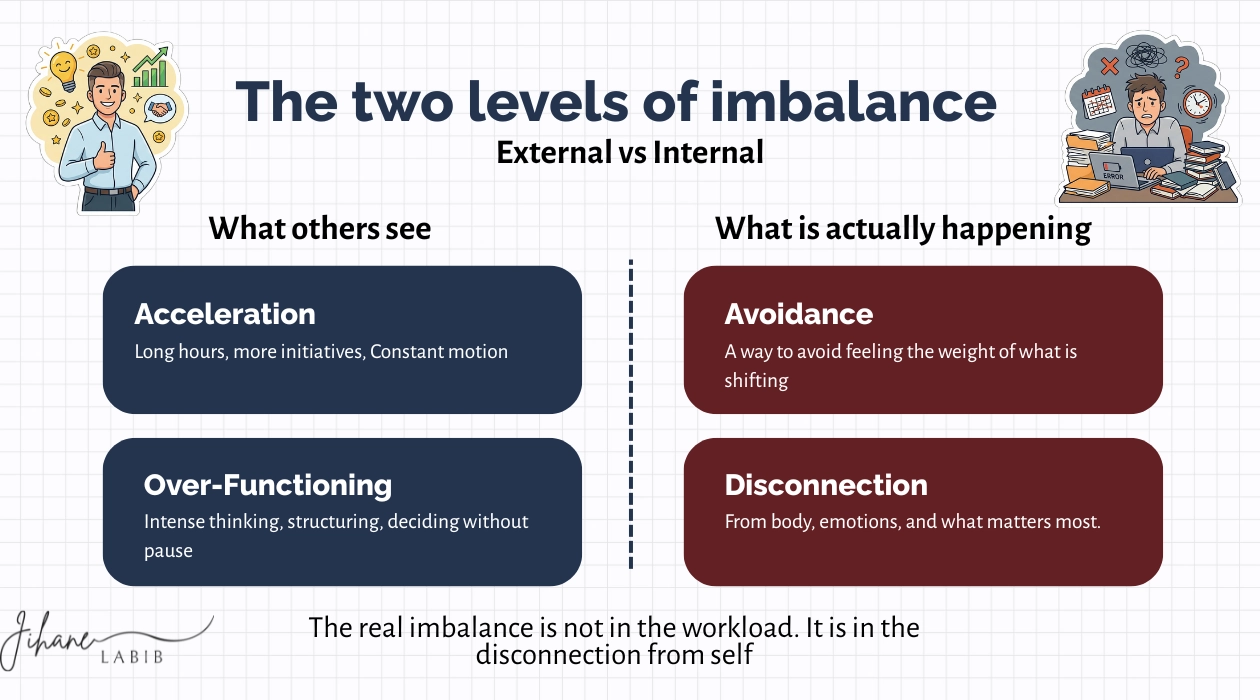
Internally, the dynamic is different. There is avoidance. A disconnection from something deeper: an unacknowledged emptiness, or a fear that has not been fully named. So the leader moves into doing. More action, more structure, more control.
But the real imbalance is not in the workload. It is in the disconnection from self.
Regaining balance does not begin with changing the agenda. It begins with a more difficult question: who am I as a leader in this moment? What remains stable in me, even when everything around me is shifting?
What helped the leader I mentioned was not working harder. It was slowing down enough to reconnect. Working with scenarios provided some short-term clarity. Coming back to values, not theoretically, but practically: what actually matters to me, and how does that shape how I lead right now?
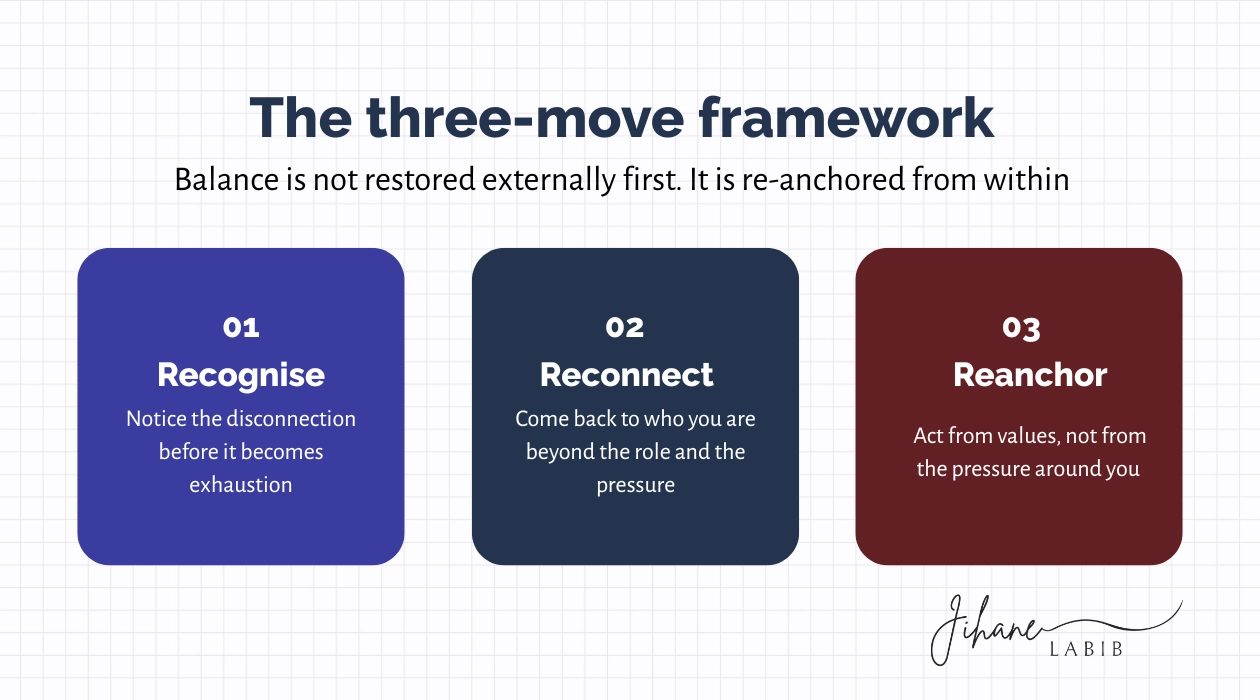
The shift was not about doing more. It was about being more real.
One thing to do differently this week
Not think. Do.
Create a small, protected pause for yourself each day. Even five to ten minutes, if that time is truly yours: no interruptions, no screens, no external noise. Not to solve anything. Not to plan. Simply to come back to yourself, beyond the role and beyond the pressure.
Start with your breath. Let it settle the system. From there, ask: what do I actually need right now? What is still solid in me?
To face an uncertain external environment, leaders need more than energy. They need inner stability. That stability is not found in constant action. It is rebuilt, deliberately, in these small pauses that allow for recentring, recharging, and leading from a more grounded place.
The map may have changed. Your inner compass has not.
Jihane Labib is an executive coach, MCC, ICF board leader, and author of Creating Bridges: Leading Growth Across Cultures and Generations.
