
Book a Call
Events
Explore executive coaching events, leadership conferences, ICF gatherings, workshops, and transformational learning experiences led or attended by Jihane Labib. Discover insights from international coaching events across the Gulf, MENA, and global executive leadership communities covering leadership development, organizational transformation, emotional intelligence, team coaching, and professional coaching excellence.
.jpg)
Thursday, June 18, 2026 | 10:00 AM – 10:45 AM EDT
Team Coaching Global Summit 2026
"Most team friction is not operational. It is cultural. And it is often invisible."
In a hyper-connected corporate ecosystem, organizational leadership and systemic team coaches face cross-cultural, multilingual environments more than ever before. Culture subtly shapes communication architectures, authority lines, psychological trust, feedback loops, and strategic decision-making in ways that remain entirely unseen—until misalignment fractures performance or stalls execution.
Drawing on her extensive background as a global systemic coach from the Global South working with international matrices, Jihane bridges the gap between organizational theory and cross-cultural execution. Grounded in the foundational research of Schein, Hofstede, Edmondson, and Meyer, this session breaks down the invisible forces shifting under multinational teams, teaching leaders how to diagnose and honor these hidden variables through a systemic coaching lens.
When cultural viewpoints are treated not as obstacles to manage, but as strategic institutional assets, they unlock an entirely new competitive advantage. Participants will walk away with actionable frameworks to challenge baseline assumptions, deepen mutual understanding, and catalyze collective intelligence and innovation safely across complex regional divides.
Upcoming

Thursday, June 18, 2026 | 10:00 AM – 10:45 AM EDT
Team Coaching Global Summit 2026
"Most team friction is not operational. It is cultural. And it is often invisible."In a hyper-connected corporate ecosystem, organizational leadership and systemic team coaches face cross-cultural, multilingual environments more than ever before. Culture subtly shapes communication architectures, authority lines, psychological trust, feedback loops, and strategic decision-making in ways that remain entirely unseen—until misalignment fractures performance or stalls execution.Drawing on her extensive background as a global systemic coach from the Global South working with international matrices, Jihane bridges the gap between organizational theory and cross-cultural execution. Grounded in the foundational research of Schein, Hofstede, Edmondson, and Meyer, this session breaks down the invisible forces shifting under multinational teams, teaching leaders how to diagnose and honor these hidden variables through a systemic coaching lens.When cultural viewpoints are treated not as obstacles to manage, but as strategic institutional assets, they unlock an entirely new competitive advantage. Participants will walk away with actionable frameworks to challenge baseline assumptions, deepen mutual understanding, and catalyze collective intelligence and innovation safely across complex regional divides.
Explore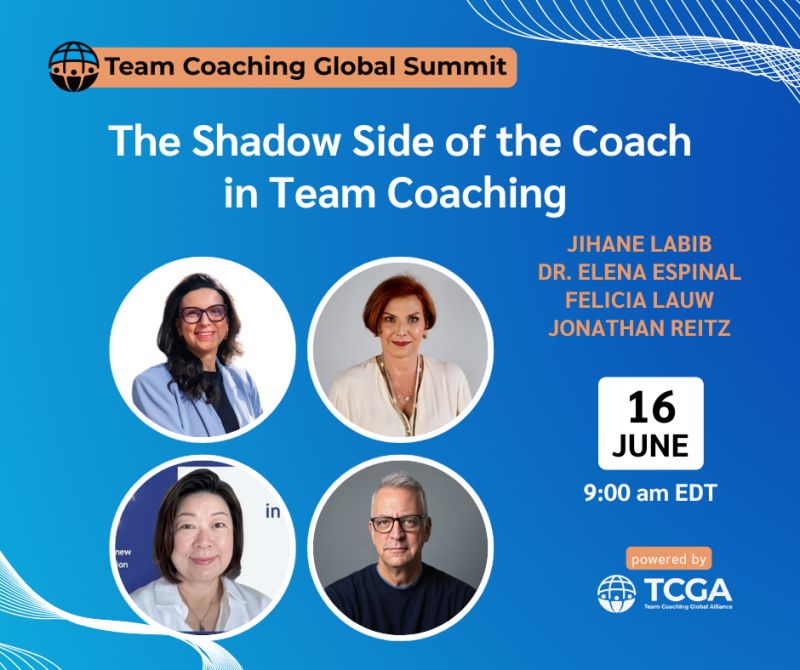
Tuesday, June 16, 2026 | 9:00 AM – 10:00 AM EDT
Team Coaching Global Summit 2026
"What if the coach is the blind spot?"
In complex organizational team coaching, the facilitator is never an detached observer—they are an active participant inside the system. A coach's individual presence, unexamined assumptions, cultural lenses, and even deliberate silences influence organizational group dynamics in deep, unseen ways. When a coach's own need to appear insightful or protective overreaches, it can unintentionally transform from an asset into the team's largest systemic roadblock.
Moving away from polished, comfortable case studies, this candid panel brings together four globally recognized master coaches to explore the raw psychological undercurrents of the profession. Drawing from foundational frameworks in coaching ethics and self-reflective supervision, the panel turns the analytical lens inward. Jihane and her colleagues will unpack how unresolved personal behaviors, hidden biases, and the avoidance of conflict subtly dictate what is brought to light and what remains suppressed during high-stakes executive interventions.
This is not a session for theoretical comfort; it is a vital diagnostic space for professional maturity. By sharpening rigorous self-awareness, building capacity for deeper supervision, and embracing vulnerable reflective practices, coaches and organizational leaders learn to safeguard ethical boundaries. The outcome is a strengthened, highly integrated presence capable of holding space for complex corporate transformations without getting caught in the system's crosshairs.
Upcoming
Tuesday, June 16, 2026 | 9:00 AM – 10:00 AM EDT
Team Coaching Global Summit 2026
"What if the coach is the blind spot?" In complex organizational team coaching, the facilitator is never an detached observer—they are an active participant inside the system. A coach's individual presence, unexamined assumptions, cultural lenses, and even deliberate silences influence organizational group dynamics in deep, unseen ways. When a coach's own need to appear insightful or protective overreaches, it can unintentionally transform from an asset into the team's largest systemic roadblock. Moving away from polished, comfortable case studies, this candid panel brings together four globally recognized master coaches to explore the raw psychological undercurrents of the profession. Drawing from foundational frameworks in coaching ethics and self-reflective supervision, the panel turns the analytical lens inward. Jihane and her colleagues will unpack how unresolved personal behaviors, hidden biases, and the avoidance of conflict subtly dictate what is brought to light and what remains suppressed during high-stakes executive interventions. This is not a session for theoretical comfort; it is a vital diagnostic space for professional maturity. By sharpening rigorous self-awareness, building capacity for deeper supervision, and embracing vulnerable reflective practices, coaches and organizational leaders learn to safeguard ethical boundaries. The outcome is a strengthened, highly integrated presence capable of holding space for complex corporate transformations without getting caught in the system's crosshairs.
Explore
14-15 May 2026 • Almaty Kazakhstan
International Coaching Week - Kazakhstan
Last week, during International Coaching Week 2026 (ICW2026) - the global initiative led by the International Coaching Federation across chapters and coaching communities worldwide - I had the honor of representing ICF Global at the ICF Kazakhstan event.
The weekend featured two key sessions that reflected some of the most important questions currently shaping the future of coaching.
The first session, held with universities, explored the evolving role of coaching in preparing the next generation of leaders for a rapidly transforming world, particularly in the context of leadership development, education, and future workplace demands.
The second session focused on coaching and artificial intelligence - examining where the profession is heading, and what it means for coaches who aim to practice with integrity, ethics, and a deeply human-centered approach in an increasingly fast-moving technological landscape.
It was also a privilege to witness the continued development of dedicated spaces for Russian-speaking coaches through the ICF Russian Language Community - an important step toward greater inclusion, cross-cultural connection, and meaningful dialogue across languages and regions.
Gratitude to the ICF Kazakhstan Chapter and the International Coaching Federation for the invitation, as well as to all participants who contributed with genuine curiosity and engagement throughout the event.
Upcoming
14-15 May 2026 • Almaty Kazakhstan
International Coaching Week - Kazakhstan
Last week, during International Coaching Week 2026 (ICW2026) - the global initiative led by the International Coaching Federation across chapters and coaching communities worldwide - I had the honor of representing ICF Global at the ICF Kazakhstan event. The weekend featured two key sessions that reflected some of the most important questions currently shaping the future of coaching. The first session, held with universities, explored the evolving role of coaching in preparing the next generation of leaders for a rapidly transforming world, particularly in the context of leadership development, education, and future workplace demands. The second session focused on coaching and artificial intelligence - examining where the profession is heading, and what it means for coaches who aim to practice with integrity, ethics, and a deeply human-centered approach in an increasingly fast-moving technological landscape. It was also a privilege to witness the continued development of dedicated spaces for Russian-speaking coaches through the ICF Russian Language Community - an important step toward greater inclusion, cross-cultural connection, and meaningful dialogue across languages and regions. Gratitude to the ICF Kazakhstan Chapter and the International Coaching Federation for the invitation, as well as to all participants who contributed with genuine curiosity and engagement throughout the event.
Explore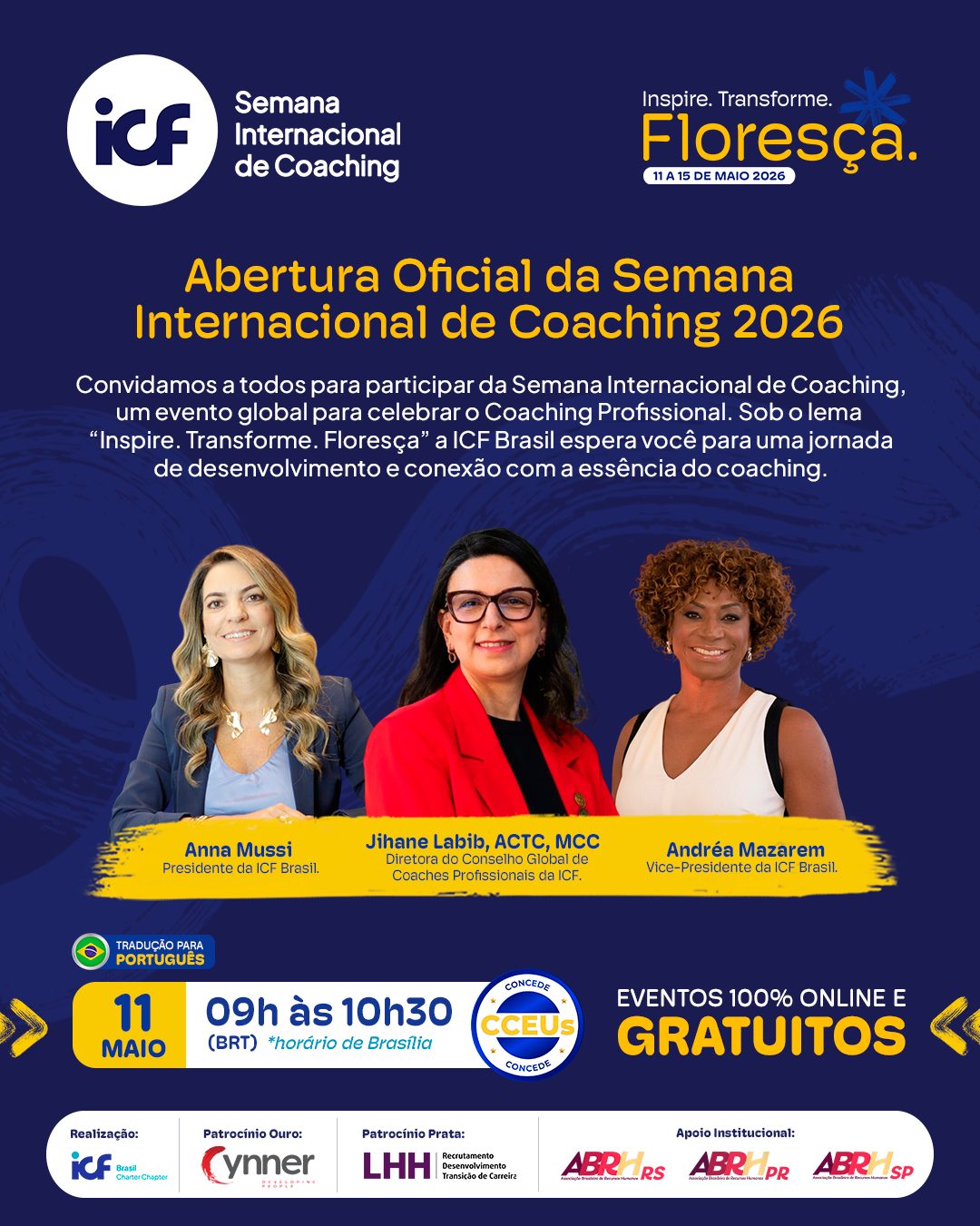
11 May 2026 • Brazil
International Coaching Week - Brazil
As ICF Professional Coaches Board Chair, I had the honor of inaugurating the official opening of International Coaching Week 2026 with the ICF Brasil Chapter, marking the start of a global celebration dedicated to advancing the coaching profession.
The opening session brought together a diverse community of coaches, leaders, and HR professionals around a shared theme: Inspire. Transform. Flourish.
The gathering reflected the continued evolution of coaching as a strategic leadership discipline, where conversations are increasingly centered on transformation at both individual and organizational levels, as well as the role of coaching in shaping future-ready leadership cultures.
This moment also highlighted the strength of the coaching community within Brazil, and the continued commitment of practitioners and leaders dedicated to advancing the standards and impact of the profession globally.
Gratitude to the ICF Brasil Chapter and its leadership team for their commitment to the coaching profession, and for creating a space that fosters dialogue, connection, and meaningful professional growth within the global coaching ecosystem.
Upcoming
11 May 2026 • Brazil
International Coaching Week - Brazil
As ICF Professional Coaches Board Chair, I had the honor of inaugurating the official opening of International Coaching Week 2026 with the ICF Brasil Chapter, marking the start of a global celebration dedicated to advancing the coaching profession. The opening session brought together a diverse community of coaches, leaders, and HR professionals around a shared theme: Inspire. Transform. Flourish. The gathering reflected the continued evolution of coaching as a strategic leadership discipline, where conversations are increasingly centered on transformation at both individual and organizational levels, as well as the role of coaching in shaping future-ready leadership cultures. This moment also highlighted the strength of the coaching community within Brazil, and the continued commitment of practitioners and leaders dedicated to advancing the standards and impact of the profession globally. Gratitude to the ICF Brasil Chapter and its leadership team for their commitment to the coaching profession, and for creating a space that fosters dialogue, connection, and meaningful professional growth within the global coaching ecosystem.
Explore%20copie.png)
11 May 2026 • Saudi Arabia
Presenting the COEUR® Framework - ICW
During International Coaching Week 2026, I had the honor of presenting for the ICF Saudi Arabia Chapter, contributing to a conversation centered on the evolving impact of coaching in leadership, transformation, and systems thinking.
The session was structured around a core question: what makes coaching truly transformational, rather than simply effective?
At the heart of the discussion was the COEUR Model, a framework designed to help coaches and leaders move from fragmented insights to coherent, sustainable action. The model reflects a systems-aware approach to coaching, where transformation is not only individual, but also organizational and relational in nature.
A key reflection from the session was the understanding that coaching is not limited to working with individuals in isolation, but extends to influencing broader systems through individuals - shaping leadership behavior, decision-making patterns, and organizational dynamics.
The exchange highlighted the growing importance of structured yet human-centered coaching approaches, particularly in regions such as Saudi Arabia and the wider Gulf, where leadership transformation and future-ready organizational development are accelerating rapidly.
Gratitude to the ICF Saudi Arabia Chapter for the invitation, and to the organizing team for facilitating the session, as well as to every participant who contributed with depth, presence, and engagement throughout the discussion.
Upcoming
11 May 2026 • Saudi Arabia
Presenting the COEUR® Framework - ICW
During International Coaching Week 2026, I had the honor of presenting for the ICF Saudi Arabia Chapter, contributing to a conversation centered on the evolving impact of coaching in leadership, transformation, and systems thinking. The session was structured around a core question: what makes coaching truly transformational, rather than simply effective? At the heart of the discussion was the COEUR Model, a framework designed to help coaches and leaders move from fragmented insights to coherent, sustainable action. The model reflects a systems-aware approach to coaching, where transformation is not only individual, but also organizational and relational in nature. A key reflection from the session was the understanding that coaching is not limited to working with individuals in isolation, but extends to influencing broader systems through individuals - shaping leadership behavior, decision-making patterns, and organizational dynamics. The exchange highlighted the growing importance of structured yet human-centered coaching approaches, particularly in regions such as Saudi Arabia and the wider Gulf, where leadership transformation and future-ready organizational development are accelerating rapidly. Gratitude to the ICF Saudi Arabia Chapter for the invitation, and to the organizing team for facilitating the session, as well as to every participant who contributed with depth, presence, and engagement throughout the discussion.
Explore