
Book a Call
Q4 is more than just a period of closing numbers and setting next year’s targets.
If you’re a leader in the GCC, you also know that Q4 is when organisations start thinking seriously about succession, leadership pipelines, and the capabilities they will need for the next phase of growth.
That’s why, across the region, succession planning and senior leadership appointments become an important part of the executive landscape in the final leg of the year.
Recent research on organisations found that 9 in 10 CEOs and board members expect their strategy or operating model to change over the next 2–3 years.
And when you step into a new role as CEO, CFO, CHRO or business head, there’s a transition that rarely appears in the appointment announcement.
How to transition into your new leadership identity?
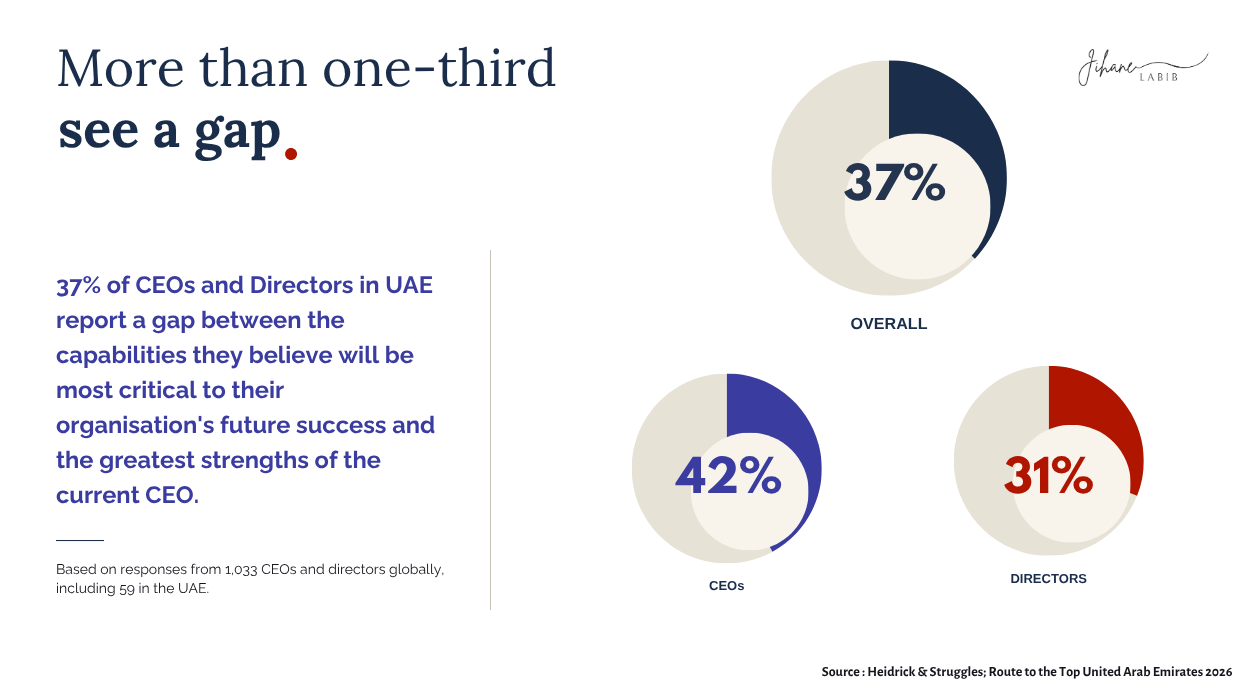
As a functional leader, the behaviours that made you successful in your previous role may not be the behaviours your new role requires.
You might be great at solving, but now you are required to enable. You are great at having the right answers, but now you have to be better at asking the right questions. You have been used to managing your function but now you’re required to influence the enterprise and teams.
Many leaders find themselves in this uncomfortable space where their responsibilities have changed, but the way they see themselves and the way they naturally operate hasn’t caught up yet.
Take Omar (name changed for privacy).
He was promoted to team lead after consistently performing well.
He had always been the person people went to when something needed to get done. He liked being independent, solving problems himself, and being the “one-man army.”
Then the promotion happened.
Suddenly, there were more meetings, more preparation, more responsibility, and much less time actually doing the work he had been so good at.
Most of his team was also older than him, which made him more conscious of how he showed up as a leader.
He had been promoted because he was good at getting things done.
But his new role required him to create the conditions for other people to get things done.
Meet Alya (name changed for privacy)
She had spent more than 15 years at a global FMCG company. When the Executive Director left, the board asked her to step in.
She knew the organisation inside out. She knew the work. She knew the people.
But something changed when she became the person everyone was looking at.
She found herself becoming self-conscious about how she looked, how she dressed, and how she came across.
She was doing the job.
She just hadn’t yet learned to see herself as the person in charge.
If either of these experiences feels familiar as you step into a new executive role, don’t just prepare for the mandate.
Prepare for the identity shift that comes with it.
If this hits a nerve, book a free discovery call to get a strategic counselling session: https://calendly.com/labibjihane/discovery-call
Small changes to help you transition better
1. Pause before solving.
When someone brings you a problem, resist the instinct to immediately provide the answer.
Ask: “What do you think we should do?”
2. Delegate ownership, not tasks.
Give your leaders responsibility for outcomes and the space to determine how they get there.
3. Build a truth circle.
Identify a few people who can challenge your thinking without being influenced by your title.
Executive support and strategic counselling can be particularly valuable during this transition.
4. Watch your old defaults.
Notice when you revert to the behaviours that made you successful in your previous role: stepping in too quickly, holding onto decisions, or needing to be the expert in the room.
5. Create a weekly leadership reset.
Take 15 minutes at the end of each week to ask:
Where did I lead at the level of my new role, and where did I slip back into my old one?
A new title changes your responsibilities.
But becoming effective in that role requires something deeper.
Your leadership identity has to catch up with it.
And perhaps that is one of the most important transitions to make before the next chapter begins.
