
Book a Call
Global Room Reflections
Globalization and generational change have turned leadership into an exercise in interpretation, where the same decision can mean entirely different things across cultures and systems. This article maps four possible futures shaped by technology and collaboration, and argues that regardless of which one unfolds, the real differentiator will be self-awareness, ethics, and relational grounding rather than frameworks or authority.

This edition is about what it takes to lead well inside the room, and what the next twenty years will demand of those who do.
The ground beneath the decision
Globalization is no longer a strategy slide; it is the ground we stand on. Cross-cultural collaboration is daily routine, and younger colleagues bring values and rhythms outside the playbook the rest of us inherited.
Tensions surface in meetings where everyone agrees and nothing moves. Inclusion scales globally but sits awkwardly against local context, often as a representation question rather than a structural one.
Inside this, leaders make decisions whose consequences will land in ten, twenty, thirty years.
Four futures, one Common Pattern
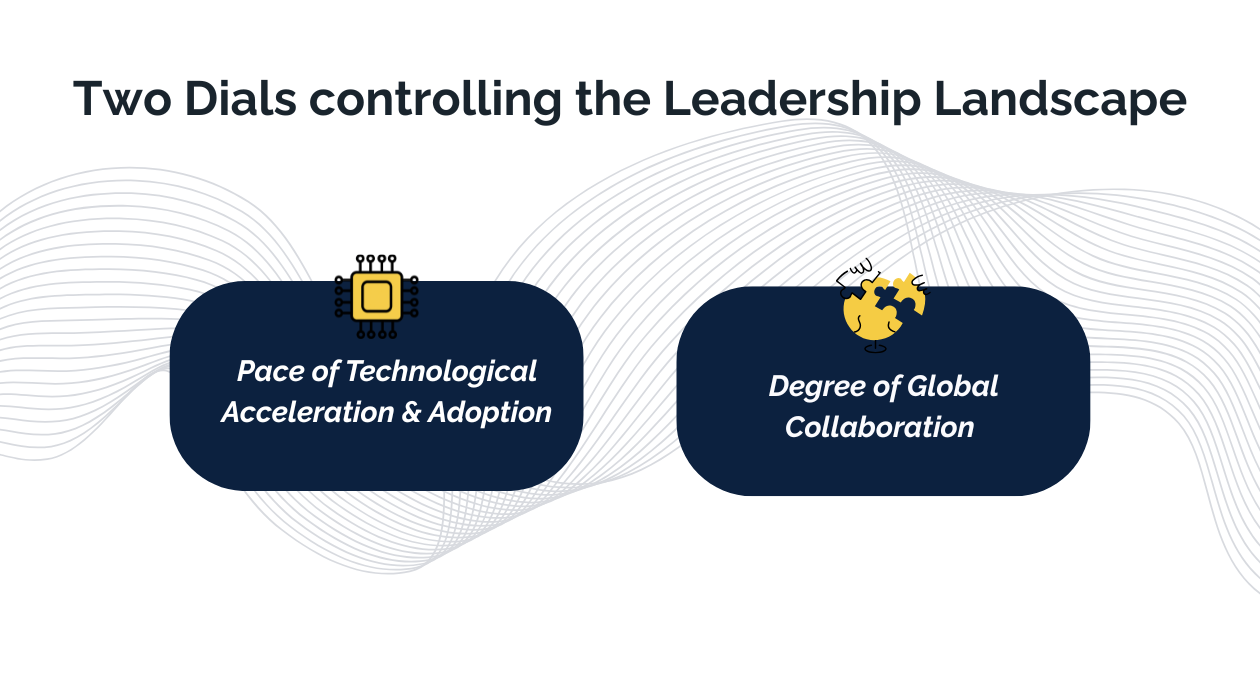
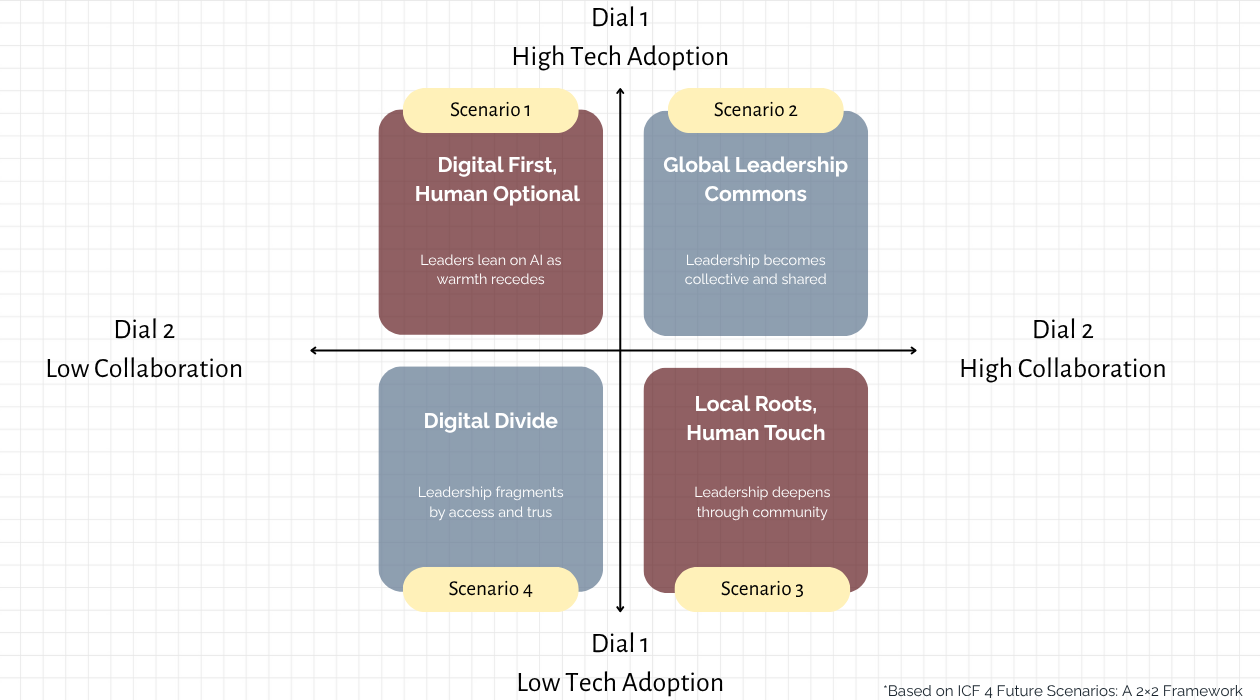
Two dials shape this landscape: technology and collaboration. Together they could play out as four scenarios over the next two to three decades. Understanding them helps leaders adapt early.
Digital First, Human Optional. Leaders operate in highly digital, data-rich but politically and socially fragmented environments, with wide gaps in access and ethics. Leadership becomes performance-obsessed, metrics-driven, and optimization-focused, because the tools make everything measurable.
Global Collaborative. Leadership and technology advance together through AI assistants, immersive platforms, and real-time feedback. Cross-sector collaboration and systems thinking become the norm, with authority distributed and adaptive.
Digital Divides. Limited tech adoption meets growing global fragmentation. Leaders work in traditional, person-centric settings, with social divisions and resource constraints that show up daily inside organizations.
Local Roots, Human Touch. Technology adoption stays cautious. People gravitate toward connection, presence, and purpose, embracing slower, contemplative approaches to wellbeing. Leadership becomes deeply embedded in strong local communities.
Whether Digital First or Local Roots, the common need is the same. Building stronger inner capacity, sharper ethics and deeper relational skills. Leadership development must move beyond tools and techniques to cultivate self-awareness, courage, and care at scale.
The tool is your mindset
I have worked with executives whose teams are structured on paper, yet engagement is low. Under pressure, they become directive and less available. They believe this older way will push the team through. It backfires. The fix is self-awareness and presence with the team inside the mess. Without it, no framework will work.
Bringing this back to your team
Leadership in an interpreted world requires more than clarity. The same moment, decision, or silence can carry entirely different meanings across cultures, generations, and systems. As technology accelerates and collaboration becomes more complex, the challenge is no longer access to information, but alignment of meaning.
Leaders who move too quickly risk mistaking agreement for understanding. The future may depend less on authority and more on the ability to hold multiple interpretations long enough for collective action to emerge.
In increasingly fragmented environments, the real leadership skill is remaining coherent, self-aware, and relationally grounded within it rather than controlling complexity.
A closing reflection
When a leader leaves a coaching session with something new about themselves, the shift does not stay private. It travels into the team. The mindset and habits you practice become your team's north star.
In the next edition, we explore how to build a coaching culture, a space for open communication, development, and authenticity in your organization.
Until then, here is the question I want you to sit with : When the room you are leading reads the same moment differently, what do you do first?
Jihane Labib is an executive coach, MCC, ACTC by ICF & MP by EMCC, She is ICF Global Board leader, and author of Creating Bridges: Leading Growth Across Cultures and Generations.
