Book a Call
Decide at 70%
In uncertain environments, waiting for perfect information can quietly cost more than a wrong decision. This article explores the 70% Rule in leadership decision-making, blending strategic frameworks with emotional intelligence to help leaders act with clarity, manage risk, and move forward with confidence, even when certainty isn’t available.

In the first edition of this newsletter, we talked about what happens internally when a leader loses their footing during a crisis. The quiet disconnection. The over-functioning that looks like strength but slowly becomes exhaustion.
This edition goes one level deeper: into the moment of decision itself.
Because what I see most often right now is not leaders who lack courage. It is leaders who are waiting. Waiting for one more data point, one more signal, one more degree of clarity before they move. And in that waiting, the cost accumulates quietly, invisibly, in ways that never show up on a risk register.
There is a name for what they are waiting for. It is called certainty. And in times like these, that certainty is simply not available.
The real risk is not a wrong decision. It is a late one.
Jeff Bezos popularised what many decision-makers now call the 70% Rule: if you have roughly 70% of the information you wish you had, move. Wait for 90% and you are already too slow. The military leadership tradition framed it similarly, Colin Powell's doctrine placed the threshold between 40 and 70 percent, arguing that acting below 40% is reckless, but waiting beyond 70% is its own form of failure.
What neither framework addresses fully is the emotional weight of that threshold. For senior leaders, the hesitation is rarely about the data. It is about what it means to be wrong. About visibility, reputation, and the responsibility they carry for others.
This is where emotional intelligence and decision-making meet.
The 70% Decision Framework: four questions that move you forward
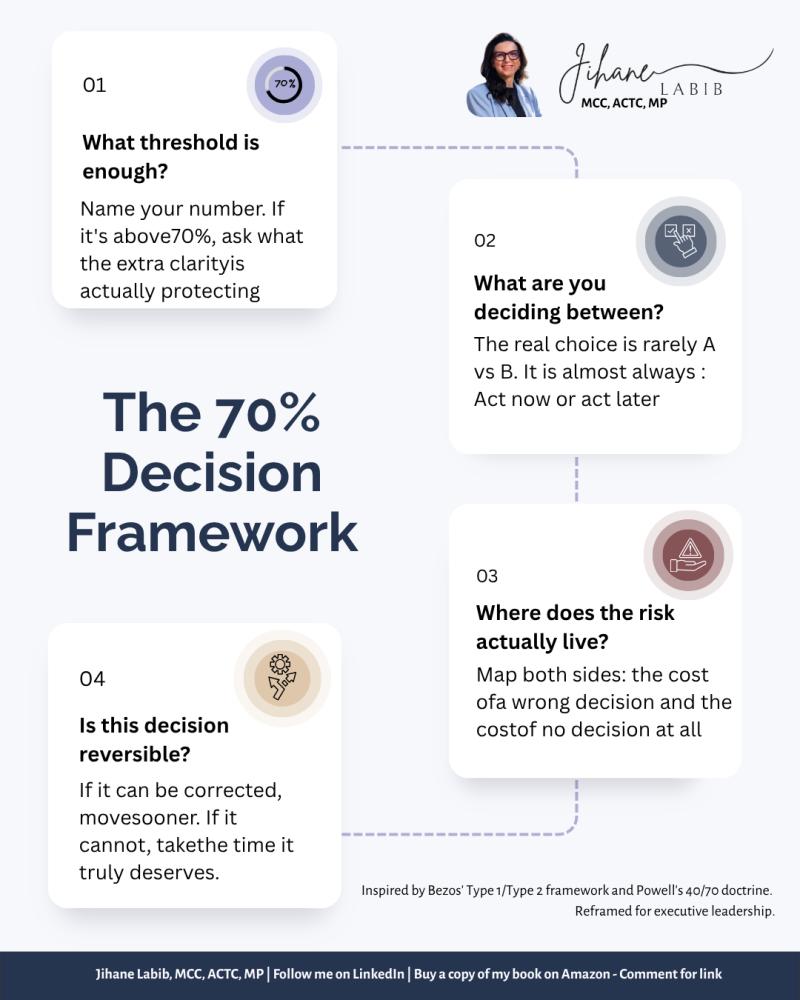
1. What threshold is actually enough?
Before any decision, name your number. Not as a performance, but as an honest internal check: what percentage of clarity would make me feel ready to move? If the answer is above 70%, ask yourself what the extra clarity is actually protecting. Often it is not the outcome. It is the feeling of certainty itself. Clarity is a leadership tool where certainty is a comfort.
2. What are you actually deciding between?
Most decisions that stall are framed as A versus B. In reality, the real decision is almost always: act now, or act later. Naming that distinction changes everything. It forces the question: what is the cost of waiting one more week, one more month? Inaction is a choice. It simply does not feel like one.
3. Where does the risk actually live?
Leaders are trained to map the risks of moving. Very few map the risks of staying still. Delayed decisions carry costs: to momentum, to team confidence, to market position, to the leader's own credibility. When you build your risk picture, include both sides. The cost of a wrong decision and the cost of no decision are not the same, but both are real.
4. Is this decision reversible?
This is the question that changes the weight of everything. Jeff Bezos called these Type 1 and Type 2 decisions: one-way doors and two-way doors. If a decision can be corrected, adjusted, or reversed, the threshold for moving drops significantly.
Ask it simply: if this turns out to be wrong, can we course-correct? If yes, move sooner. If no, take the time the decision genuinely deserves.
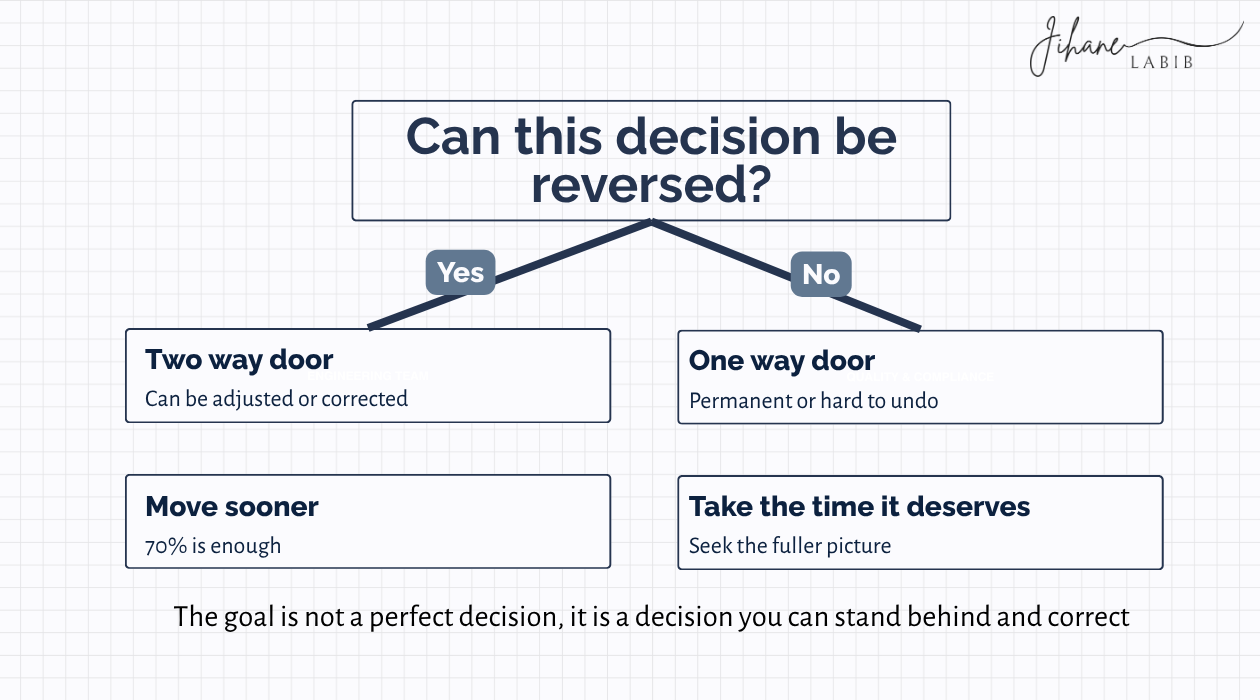
The goal is not a perfect decision. It is a decision you can stand behind and correct.
Leadership under uncertainty is not about having the fullest picture. It is about developing the capacity to act clearly with an incomplete one, and to remain grounded enough to adjust when new information arrives.
The leaders I work with who navigate this well share one quality. They have made peace with the threshold. They know that 70% is not settling. It is judgment. And judgment, not certainty, is what leadership has always required.
This week, before your next significant decision, ask yourself: do I have 70%? If yes, what am I still waiting for?
If this resonated, the previous article explored what happens inside a leader when the map disappears entirely, the quiet disconnection, the over-functioning that looks like strength, and how to find your footing again. You can read it here.
Jihane Labib is an executive coach, MCC, ICF Board Chair 2026, and author of Creating Bridges: Leading Growth Across Cultures and Generations. This newsletter goes out twice a month, on Fridays. Subscribe to receive each edition directly.
